
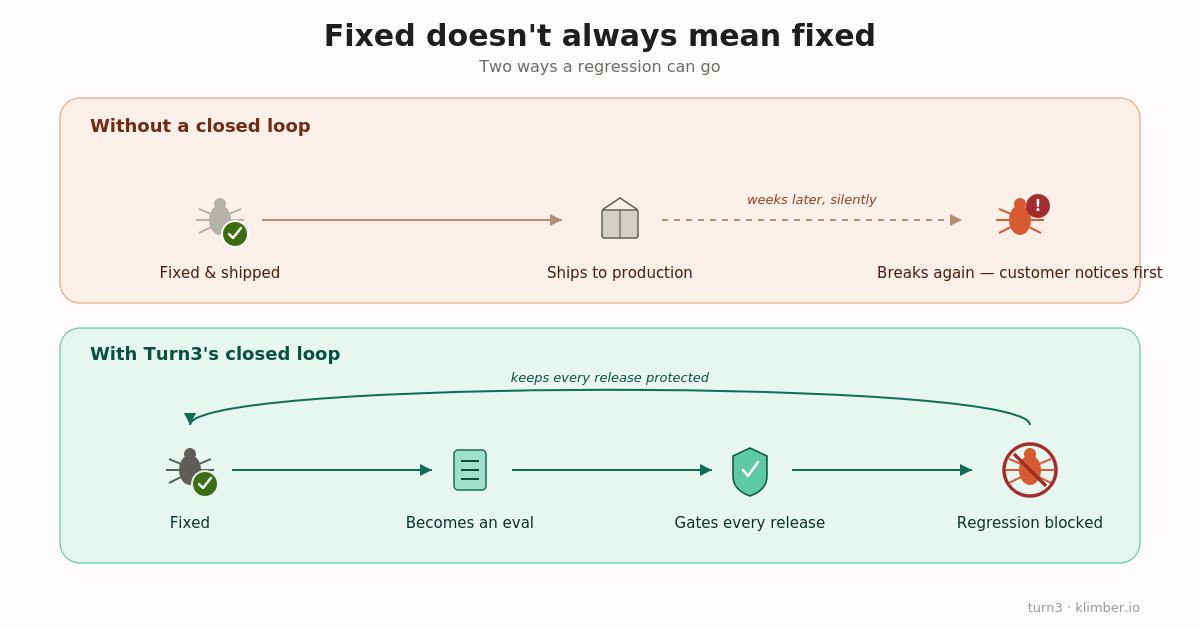

You closed the ticket. You wrote the fix. You watched it pass review, merge, and ship. By every measure your team trusts, that bug was dead.
It shipped again yesterday. Nobody noticed until the customer did.
Why “fixed” doesn’t stay fixed
In traditional software, a fix is durable. The line of code that caused the bug is gone, replaced by the line that doesn’t. Ship it, and it stays fixed until someone deliberately changes that code again.
AI agents don’t offer you that guarantee, and most teams don’t realize it until the regression comes back.
Here’s what actually happens underneath your agent, quietly, without asking your permission:
- Model providers update silently. The model you built and tested against isn’t the model serving your customers today. A provider ships a routine update, and the specific behavior you patched around shifts back.
- Prompts drift. Someone tweaks a system prompt for an unrelated reason. A retrieval step gets reordered. A tool description changes. None of it looks related to the bug you fixed months ago, until it resurrects it.
- Nothing throws an error. This is the part that makes it dangerous. A regressed agent doesn’t crash, log an exception, or trip an alert. It responds fluently, confidently, and wrong, exactly the way it did the first time.
Your fix didn’t fail. Your ability to know it failed did.
The blind spot every eval suite has
Most teams’ answer to this is a regression test suite: write a test for the bug, run it in CI, done. It’s the right instinct, and it’s usually incomplete, for a simple reason: you can only write a test for a failure you already know to look for.
Real agent failures don’t announce themselves that cleanly. They surface in production, across sessions your test suite never imagined, in conversations three or four turns removed from anything a QA script would script. By the time a human notices the pattern repeating, it’s already reached customers, and nobody connects “this feels familiar” to “we fixed this exact thing in March.”
The gap isn’t effort. It’s architecture. A test suite only protects against what you thought to test. Something else has to watch for the fix breaking, without you having to remember it exists.
Closing the loop: from failure to permanent fix
This is the problem Turn3 is built to close, end to end, with no manual step in the middle:
→ Find. Turn3 reconstructs every production session from the telemetry your agents already emit, and identifies the exact turn where things went wrong, not the turn where the symptom finally became visible.
→ Cluster. Individual failures don’t sit in a flat list. They group into tracked issues by root cause, and each issue carries a real state: active, resolved, or regressed. “Regressed” is the status most tools don’t even have a name for.
→ Generate. Every real failure automatically becomes an eval. You’re not hand-writing test cases from memory weeks after the fact. The production failure is the test.
→ Gate. Those evals sit in your CI/CD pipeline. A build that reintroduces a fixed failure doesn’t ship. It gets caught before it ever reaches a customer again.
The loop isn’t a feature bolted onto monitoring. It’s the whole point: production traffic finds the failure, judgment identifies the root cause, the failure becomes a permanent test, and the test protects every release after it.
Why a dashboard isn’t enough
Most observability tools stop at the first step. They’ll tell you something looked wrong, hand you a trace, and leave the rest to you: figuring out if it’s the same bug as last time, remembering to write a test for it, remembering that test exists six months later when a model update quietly reopens the hole.
That’s a lot of institutional memory riding on humans not being busy, distracted, or new to the team.
Turn3 doesn’t ask you to remember. “Fixed” becomes a tracked state, not a hope. If the same failure mode reappears, whether from a prompt change, a model update, or a rerouted tool call, it doesn’t quietly slip back into production. It gets caught in CI, flagged as a regression, and stopped before a customer becomes the one who notices.
Make “fixed” mean fixed
The bugs coming back into your agents right now aren’t new bugs. Most of them are old ones, wearing a slightly different disguise, exploiting the exact gap between “we fixed it” and “we have no way of knowing if it broke again.”
Turn3 closes that gap.
Book a walkthrough → turn3@klimber.io