Turn3 gives each AI stakeholder a different answer: prevent customer harm, find reliability breaks, prove control, or show leadership that AI quality is improving.
Choose a domain, then click any turn. Turn3 connects business outcomes, evidence, guardrails, and the customer-facing results.
Domain
session · prior-auth-assistant · member ****1842 · 8 turns
session closed
1PatientWhy was my specialty-med request denied—and how do I appeal?goal captured
2AgentI’ll check the authorization case, payer decision code, and appeal requirements.session stitched
3AgentPayer returned PA-17. I’m treating it as a medical-necessity denial.tool: payer-statusROOT CAUSE
4AgentI’ll search the medical-necessity appeal policy for the next steps.tool: policy-search
5AgentThe chart shows a prior therapy attempt that may support the request.tool: chart-summary
6AgentI’ll prepare the customer-facing explanation and list the documents to attach.drafting
7AgentDenied for medical necessity. ID 004182; asthma diagnosis.Turnguard: PHI + unsupported reasonBLOCKED
8AgentPA-17 needs step-therapy documentation. Here’s the appeal checklist.safe rewrite delivered
1root cause identified
3tool calls reconstructed
1PHI response rewritten
8¢estimated evaluation cost
Why a bad turn matters
A wrong answer is not just a model problem.
When an agent takes the wrong turn, the cost shows up outside the trace: in a patient’s next call, a missed SLA, a compliance review, a lost conversion, or another night of downtime. Turn3 connects the causal break to the customer and operating consequence.
+
Healthcare
Wrong denial explanation
What the customer sees
A payer code is misread as medical necessity, so the patient receives the wrong reason for denial.
What it costs
More appeals and contact-centre work, compliance and reputational exposure, and less trust in the automated workflow.
→
Supply chain
Wrong ETA or recovery path
What the customer sees
A carrier exception is misread, so the agent promises the wrong arrival time or reroute.
What it costs
Missed SLA, expedited freight, avoidable customer updates, and margin leakage.
$
Financial services
Unsupported explanation
What the customer sees
A status or policy code is mapped to the wrong reason, and the agent explains a decision it cannot support.
What it costs
Manual review, compliance risk, remediation work, and a customer who cannot trust the answer.
↗
Retail
Wrong recommendation or service answer
What the customer sees
The agent drops a preference, policy constraint, or order context mid-session.
What it costs
Lost conversion, repeat contacts, refund leakage, and a customer who has to start over.
!
SaaS / IT ops
Wrong remediation
What the customer sees
An agent follows a stale or contradictory signal and applies the wrong fix.
What it costs
Longer downtime, duplicate incidents, engineer escalation, and a slower recovery path.
↳
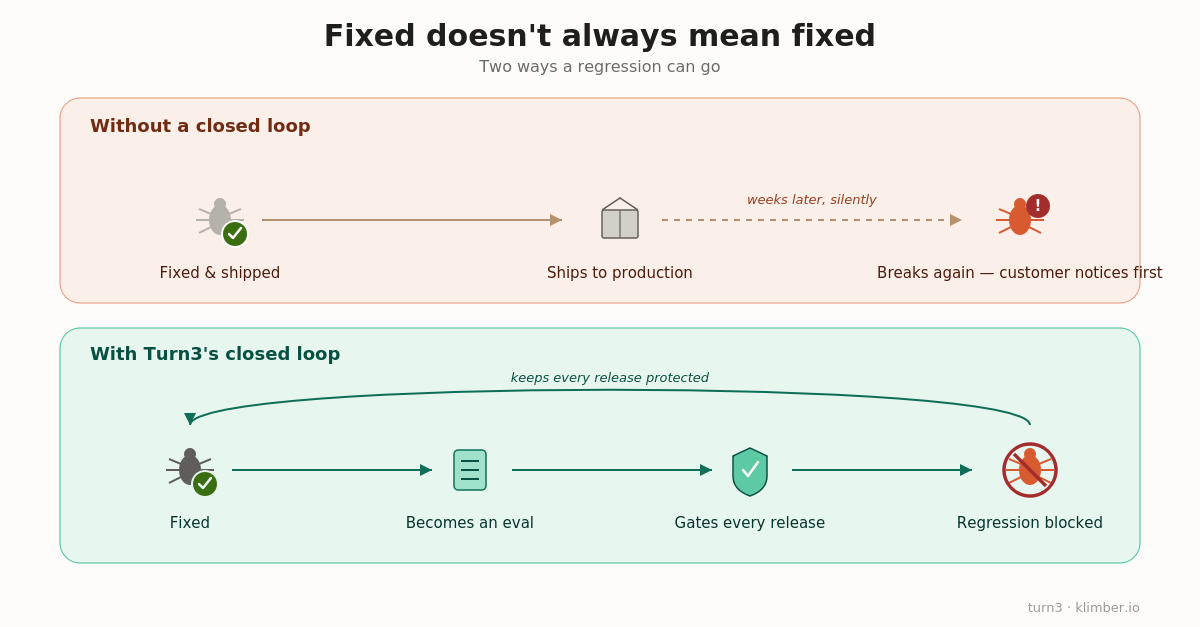
Turn3’s job: identify the first causal break, show the evidence behind it, and stop the customer-visible consequence before it ships. See the broken session above.